
Custom model configuration
Field reference
Section titled “Field reference”| JSON field | Purpose | Guidance |
|---|---|---|
name |
Provider display name | Use a recognizable name such as Team gateway |
baseUrl |
API root | Usually ends in /v1; do not append /chat/completions twice |
api |
Request protocol | Usually openai-completions or openai-responses |
headers |
Extra HTTP headers | Include only gateway-required headers, not the API key |
models[].id |
Server-side model ID | Copy it exactly from the provider |
models[].name |
Composer label | Human-readable and not sent as the ID |
reasoning |
Reasoning capability | Set only when the model really supports it |
input |
Input modalities | ['text'] or ['text', 'image'] |
contextWindow |
Context limit | Use the provider’s published value |
maxTokens |
Maximum output | Keep within the model/API limit |
thinkingLevelMap |
Wordless depth to provider value | Supports off, minimal, low, medium, high, xhigh, max keys |
Configure an OpenAI-compatible gateway
Section titled “Configure an OpenAI-compatible gateway”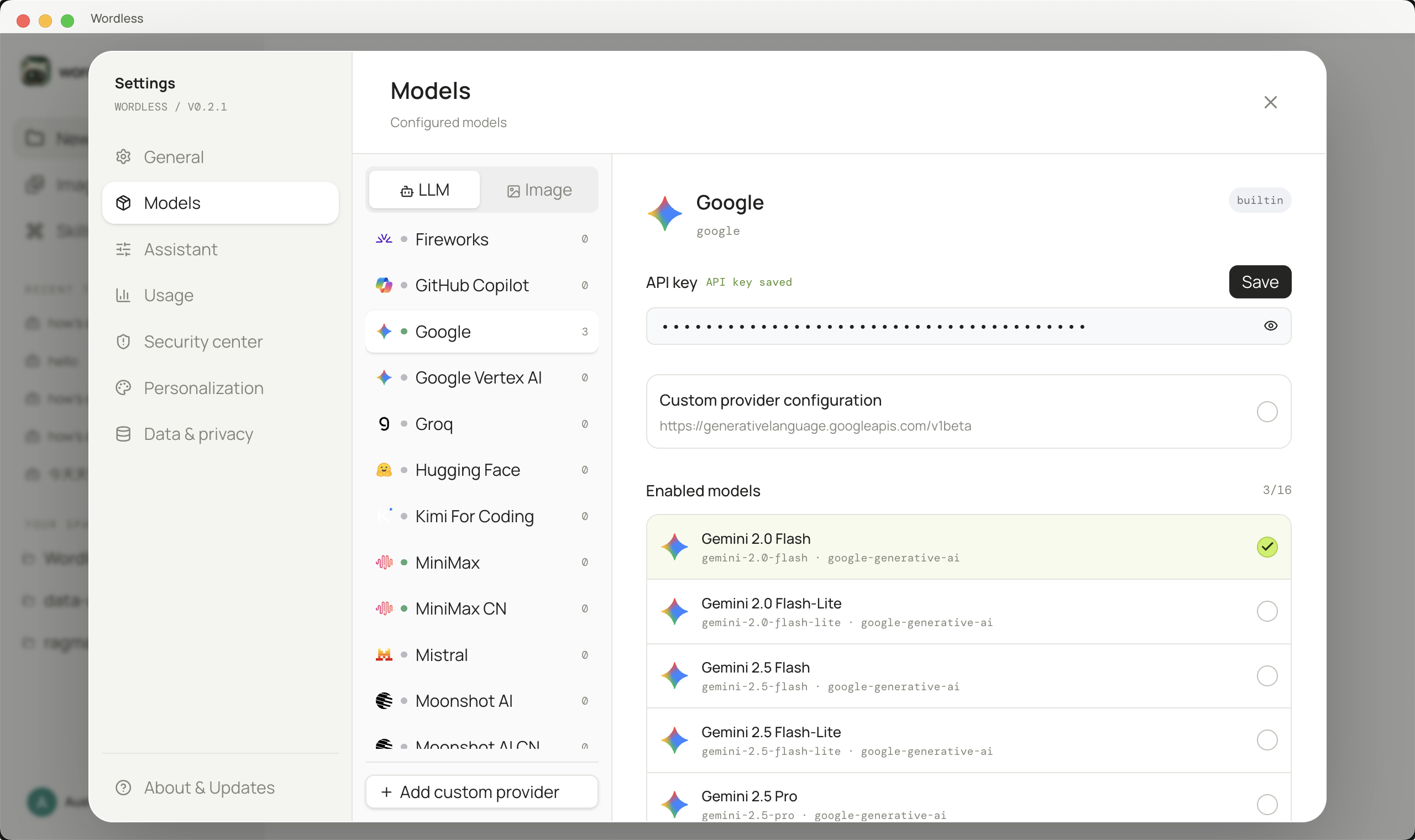
- Open Settings → Models and select Chat.
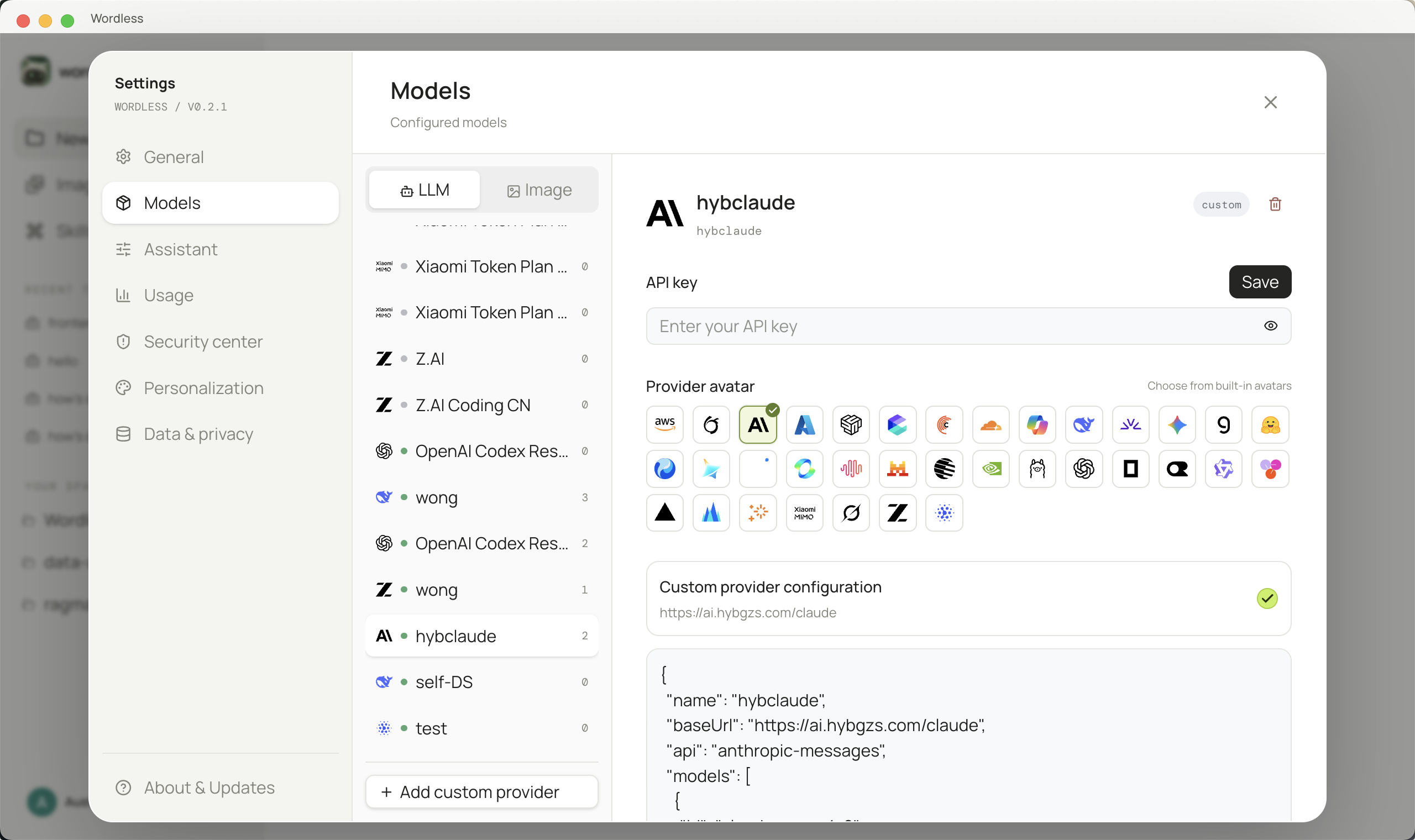
- Click Add custom provider, enter a unique Provider ID using letters, numbers,
.,_, or-, choose an avatar, and create it. - Enter the API key on the right. It is kept separate from the advanced JSON.
- Enable Custom provider configuration and adapt the example below.
- Click Save; schema errors appear below the API key section.
- Enable the new model under Enabled models or it will not appear in Composer.
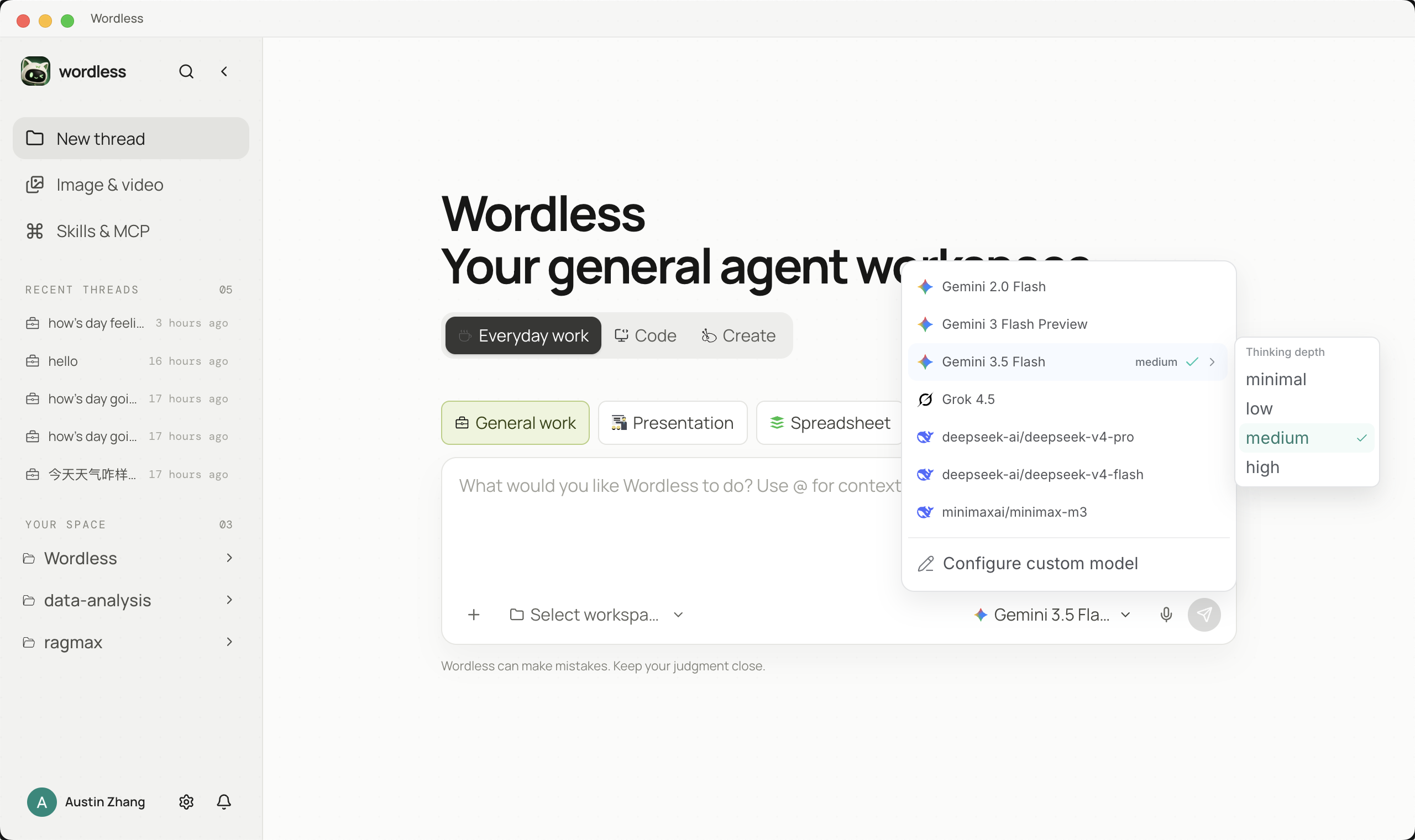
- Select it in Composer. A thinking-depth submenu appears only when
thinkingLevelMapis configured.
{ "name": "Company AI", "baseUrl": "https://model.example.com/v1", "api": "openai-completions", "headers": { "X-Client": "Wordless" }, "models": [ { "id": "chat-model-prod", "name": "Company Chat", "reasoning": true, "input": ["text", "image"], "contextWindow": 128000, "maxTokens": 16384, "thinkingLevelMap": { "off": "none", "low": "low", "medium": "medium", "high": "high" } } ]}For a built-in provider, use modelOverrides in Custom provider configuration instead of recreating it. Assign null to an inherited thinking level to disable that level explicitly.
Troubleshooting configuration
Section titled “Troubleshooting configuration”401/403 usually means an invalid key or missing model permission. A 404 usually means the base URL has the wrong /v1 suffix or the Model ID is wrong. A timeout points to proxy, VPN, IPv6, or local routing. HTML means a console URL was entered instead of an API endpoint. An empty model list means models is empty, JSON validation failed, or the model is not enabled. If thinking depth is absent, thinkingLevelMap is not configured.